Wellbeing Natural Therapies
CLINICAL REFLEXOLOGIST, REIKI PRACTITIONER IN BIDEFORD, NORTH DEVON
Supporting women through perimenopause, menopause and midlife change.
Holistic and intuitive wellbeing support in Bideford and across North Devon, combining clinical reflexology, Reiki, energy work and a whole-person approach tailored to you.

Synergy Pattern Assessment
Stop guessing what is wrong. Start understanding the pattern.
You may already know that something is not quite right.
You feel overwhelmed more easily than you used to.
You keep finding yourself in the same emotional situations.
Your body feels tense, depleted or unsettled.
You have tried to rest, think positively, push through or make changes, but somehow you end up back in the same place.
You may understand parts of the problem, but not how they all connect.
This Synergy Pattern Assessment is designed to help you make sense of what is happening beneath the surface.
Together, we will explore the emotional patterns, coping responses and physical signs that may be keeping you stuck in the same loop, so you can begin to see the bigger picture rather than treating each symptom as a separate problem.
You may recognise yourself here
Perhaps you are the person everyone relies on.
You keep going, even when you are exhausted. You take responsibility for how other people feel. You find it difficult to switch off, say no or fully relax because part of you is always waiting for the next thing that needs your attention.
Or perhaps you keep finding yourself in familiar emotional patterns.
- You overthink. You doubt yourself. You struggle to make decisions. You know what you should do, but something inside you seems to pull you back towards the same reactions, relationships or behaviours.
- You may also feel that your body is carrying something your mind cannot quite explain.
- Tension, fatigue, digestive discomfort, headaches, disrupted sleep or a persistent sense of being on edge may continue even when you have tried to slow down.
None of this means that you are failing.
It may mean that your body and your emotional responses have been adapting for a long time, and the pattern now needs to be understood rather than pushed through.
What Client's say:
"Jill is wonderful..and for once I feel they are helping me no end"
"It was the best appointment I have made; Jill had given me more than I could hope for to mentally deal with the situation. I am enormously grateful to her."
"Jill has a magic and power like no other. She has a wonderful ability to make you feel seen and heard both in the room talking to her and through her healing practice. I didn’t know what I needed when I went to see Jill, and yet she has somehow given me more than I could imagine.
A safe, supportive and nurturing experience I keep coming back to. Thank you Jill!"
60 + 5 Star Reviews - READ MORE Here

Why the same problems keep returning
Most people focus on the most obvious symptom.
They try to calm the anxiety, manage the pain, improve their sleep or stop overthinking. These things may help for a while, but if the underlying pattern has not been recognised, the same difficulties can keep returning in slightly different forms.
You may deal with one problem, only for another to appear.
You feel better briefly, then find yourself back in the same emotional place.
You understand something intellectually, but your body still reacts as though nothing has changed.
That is because patterns do not only exist in the mind.
They can also show up through the nervous system, the body, your energy, your coping responses and the way you relate to yourself and other people.
The purpose of this session is to begin connecting those pieces.

What we will explore together
Your Synergy Pattern Assessment begins with a focused conversation about what has been happening, what you feel stuck in and how you would like to feel instead.
- We will look at:
- the main issue bringing you to the session
- patterns that appear to repeat
- how you respond when you feel under pressure
- what you may be carrying emotionally
- where tension, depletion or imbalance may be showing in the body
- how these different areas may be connected
This is not about analysing every part of your past or finding something else that is wrong with you.
It is about identifying the clearest pattern that may be influencing how you feel now.
A body-led assessment, not just a conversation
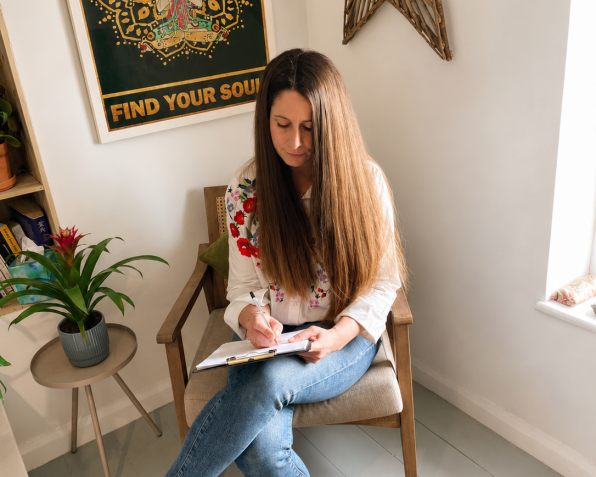
After the initial discussion, the session moves into a combination of reflexology, Reiki and intuitive body-based assessment.
Reflexology allows me to notice areas of tension, sensitivity or imbalance through the feet.
Reiki and energy work create space for the body to settle and may highlight where energy feels depleted, blocked or overactive.
Sound healing may also be used where it feels supportive.
Throughout the session, I pay attention to the physical, emotional and energetic themes that appear to connect with what you have shared.
The aim is not to make dramatic claims or interpret every sensation.
It is to gather the clearest and most relevant information, so we can begin to understand the pattern as a whole.
The Synergy Pattern Assessment
At the end of the session, I will bring together what has emerged from the conversation, the reflexology assessment, the energy work and my intuitive observations.
We will identify:
- the central pattern that appears to be keeping you stuck
- the emotional themes connected to it
- how the pattern may be showing up in your body
- the coping response that may be maintaining it
- the direction that would feel most supportive moving forward
You will not leave with a long list of everything that could be wrong.
You will leave with a clearer understanding of the main pattern that needs attention.
What you will take home
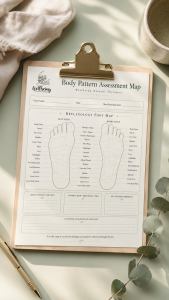
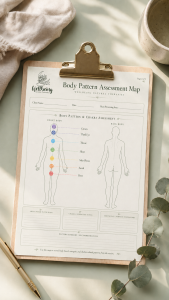
You will receive your own printed assessment maps and a written pattern summary to take away with you.
These are designed to help you see the connections clearly and give you something practical to return to after the session.
Your take-home information will include:
- your foot assessment map
- your body and energy map
- your pattern summary
- your recommended focus
- the next pathway I believe would support you best
This means you do not have to remember everything discussed during the session or leave wondering what it all meant.
You will have a clear record of what was identified and what the next step could be.
This session may be right for you if
- You are tired of treating every symptom as a separate problem.
- You sense that your emotional wellbeing and physical symptoms may be connected.
- You keep repeating the same reactions, behaviours or relationship patterns.
- You feel overwhelmed, depleted or unable to switch off.
- You want insight, but you also want a clear direction rather than another open-ended conversation.
- You are ready to take part in the process rather than waiting for someone else to fix you.
Your Synergy Pattern Assessment
A 90-minute assessment combining focused conversation, reflexology, Reiki, body and energy mapping, intuitive guidance and a clear recommendation for your next step.
You will leave with your printed maps, pattern summary and recommended pathway.
Investment: £95
Book your Synergy Pattern Assessment

Get in touch
If you are considering working together, the first step is to book an Initial Session & Assesment.
Sessions take place at my clinic in Northam, near Bideford in North Devon, offering clinical reflexology and Reiki therapy for women experiencing stress, tension and burnout. Many clients travel from Barnstaple and across North Devon, including Bishops Tawton, Umberleigh, South Molton, Braunton, Croyde, Fremington, Instow, Appledore, Westward Ho!, Bude and Exmoor.
Frequently asked questions
Everyone is different and the response to Reflexology can be immediate or sometimes take longer than one appointment, but often benefits can be seen after 4-5 sessions. Regular weekly treatments are best for the body properly beginning the self-healing process, and following an initial consultation I will suggest the number of Reflexology sessions I think we should undertake.
Reflexology sessions for individuals last 50 minutes and cost £60 per session. I also provide a limited number of appointments for those on low-income; contact me to enquire about availability.
Note that if you want to cancel an appointment I require 48 hours’ notice; otherwise you will still need to pay for any sessions missed. I accept payment in cash, by cheque or by bank transfer.
Reflexologists cannot claim to diagnose or cure, but during a treatment we get 'feedback' as to which parts of the body are working well and which are not. Sometimes Reflexology will highlight a specific area which is struggling or working hard to maintain your wellbeing; if a particular reflex point shows this kind of reaction I'll discuss it with you at the end of the session.
Reflexology is performed entirely on the feet, ankles or hands, so the most you’ll have to do is take off your socks and roll up your trousers! During the treatment the client lies on their back on a reclining chair, supported by pillows and covered with a soft blanket to keep them warm.
And don’t worry - reflexology doesn't tickle! Many clients come to me with ticklish feet or worried about their feet being touched, but find they can relax and enjoy the benefits of Reflexology.
You might find some areas feel sensitive to the touch, but Reflexology does not involve hard pressing in the way something like a sports massage might. As a therapist I will be aware of the status of your feet, noticing how they feel, the temperature and colour. All these things play a part in understanding which areas of your body - as reflected through your feet - require a bit more care and attention.
Not necessarily, but after an initial course of treatment many people choose to check in monthly for a top-up, to help maintain their general wellbeing, or as a scheduled 'de-stress'. Other clients will get back in touch if they start feeling aches and pains, arranging treatments as and when they need them.